The emission schedule
STRIP emissions follow a fixed exponential decay, set at deployment and unchangeable thereafter: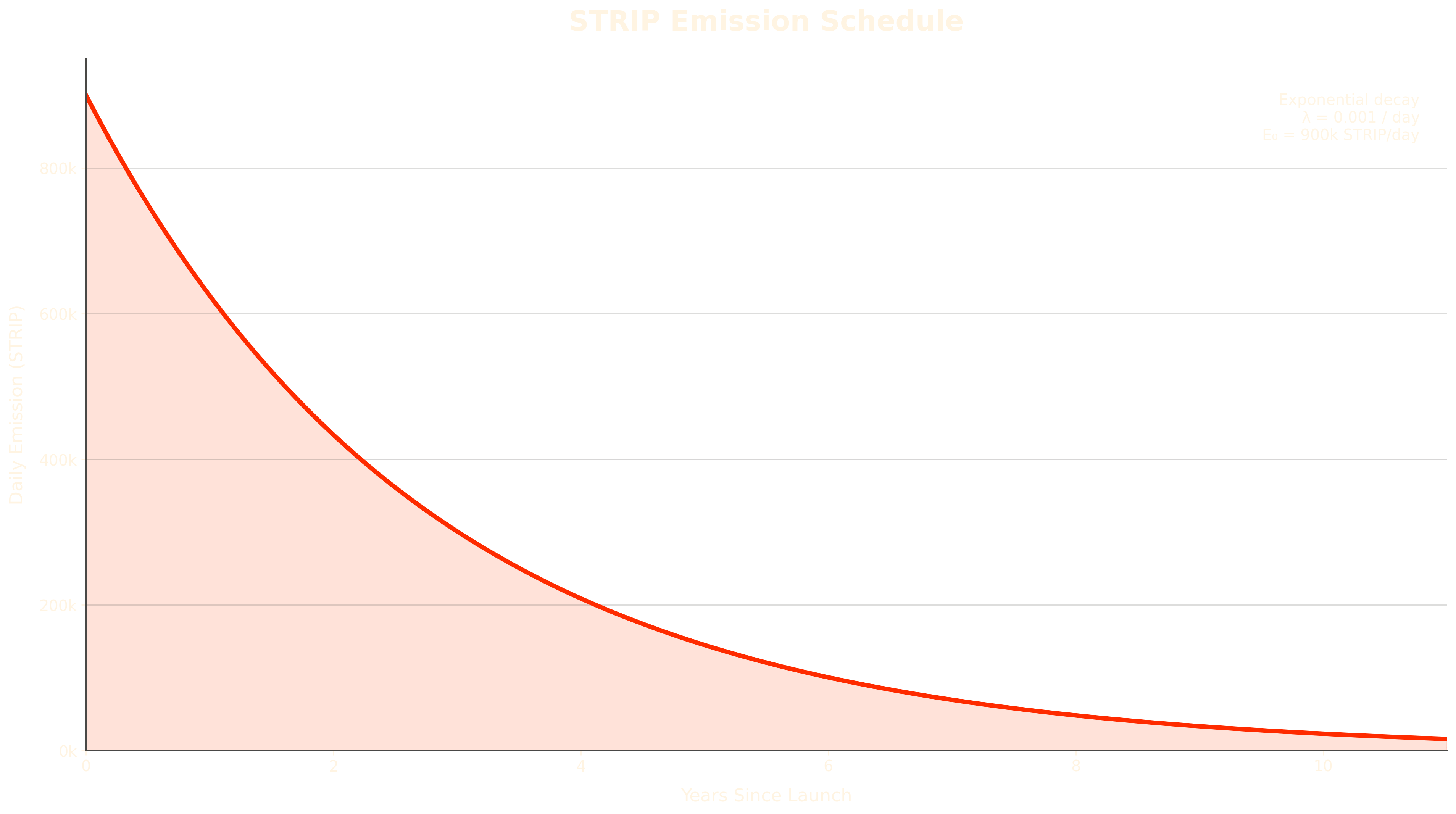
The schedule is a ceiling, not a promise of circulation
Scheduled emissions define the maximum that can enter circulation, for two reasons. First, STRIP is only minted at claim time; nothing sits pre-minted waiting to move. Second, every claim is scaled by the boost the claimant held during the epoch the rewards were earned. A participant below maximum boost claims proportionally less than their scheduled maximum, and the difference is never minted. It does not roll over to other users or later epochs; it simply never enters circulation. Realized emission is therefore always at or below the curve, and the gap is set by how much of the system’s stake is held by participants with sustained alignment. Sustained alignment is what converts the schedule into supply.The burn
Burn is not scheduled; it is driven by realized yield. As supported collateral generates output, Strip routes half of it into STRIP buybacks, and bought STRIP is burned. The burn rate therefore scales with the productive base: more collateral and higher realized yields mean more STRIP removed per cycle. Every burn is verifiable on the transparency dashboard.The four phases
The interaction of a decaying, scheduled distribution with a growing, yield-driven burn produces a supply path in four phases:- Coordination. Emissions distribute STRIP to early aligned participants (PT stakers and PT/STRIP liquidity providers) and establish the productive base. Genesis is the opening act of this phase: the base builds and a month of routed yield accumulates before price discovery begins, ready to deploy as buybacks once trading opens.
- Competition. STRIP enters circulation and users compete across PT staking, PT/STRIP liquidity, and stSTRIP. Boost matters most here: participants with similar capital earn different reward shares depending on sustained alignment.
- Crossover. Routed yield becomes large enough to meaningfully offset new emissions. STRIP is still being distributed, but it is also being consistently bought and burned.
- Scarcity. Emissions decline toward residual levels and burn can become the stronger force. If burn exceeds new emissions, net circulating supply contracts.